


 Cart
Cart
 sales@molnova.com


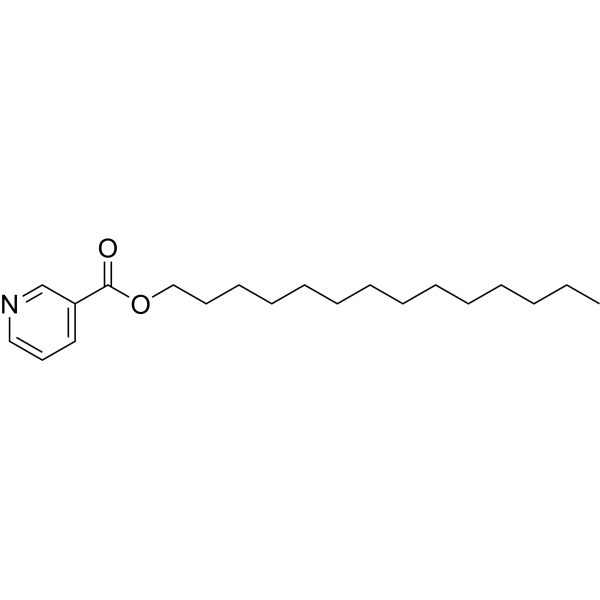
Myristyl nicotinate
CAS No. 273203-62-6
Myristyl nicotinate( Tetradecyl nicotinate )
Catalog No. M27090 CAS No. 273203-62-6
Myristyl nicotinate is an ester prodrug being developed for delivery of nicotinic acid (NIC) into the skin for prevention of actinic keratosis and its progression to skin cancer.
Purity : >98% (HPLC)
 COA
Datasheet
HNMR
HPLC
MSDS
Handing Instructions
COA
Datasheet
HNMR
HPLC
MSDS
Handing Instructions
| Size | Price / USD | Stock | Quantity |
| 100MG | 41 | In Stock |


|
| 200MG | Get Quote | In Stock |
|
| 500MG | Get Quote | In Stock |
|
| 1G | Get Quote | In Stock |
|
Biological Information
-
Product NameMyristyl nicotinate
-
NoteResearch use only, not for human use.
-
Brief DescriptionMyristyl nicotinate is an ester prodrug being developed for delivery of nicotinic acid (NIC) into the skin for prevention of actinic keratosis and its progression to skin cancer.
-
DescriptionMyristyl nicotinate is an ester prodrug being developed for delivery of nicotinic acid (NIC) into the skin for prevention of actinic keratosis and its progression to skin cancer.(In Vitro):Myristyl nicotinate is an ester prodrug under development for delivery of nicotinic acid to skin for treatment and prevention of conditions that involve skin barrier impairment such as chronic photodamage and atopic dermatitis or for mitigating skin barrier impairment that results from therapy such as retinoids or steroids.?The formulation stability of Myristyl nicotinate is crucial because even small amounts of free nicotinic acid cause skin flushing, an effect that is not harmful but would severely limit tolerability.(In Vivo):Retinoic acid therapy resulted in stratum corneum thinning of approximately 25% (P = 0.006 versus baseline) that was ameliorated by Myristyl nicotinate use (P < 0.005). Therapy resulted in an increased rate of transepidermal water loss (TEWL) of approximately 45% (P = 0.001 versus baseline) and use of Myristyl nicotinate protected against the increase in TEWL with the strongest protection provided by prior use of Myristyl nicotinate (P = 0.056 versus placebo). Myristyl nicotinate use reduced the incidence of side-effects of the therapy and again prior use provided the greatest reduction of side-effects. Subjects showed statistically significant clinical improvement (P < 0.05 versus baseline) during the study. Myristyl nicotinate use did not interfere with any clinical improvement parameters and improved effects on temple laxity (P = 0.01 versus placebo). Analysis of changes in epidermal thickness, Ki67-positive cells and intensity of loricrin staining demonstrated that Myristyl nicotinate either improved or did not interfere with retinoic acid efficacy. These results show that prior and concurrent use of Myristyl nicotinate can mitigate barrier impairment and improve the tolerability of retinoic acid therapy for facial photodamage without interfering with efficacy.
-
In VitroMyristyl nicotinate (Tetradecyl nicotinate) is used for treatment and prevention of conditions that involve skin barrier impairment such as chronic photodamage and atopic dermatitis or for mitigating skin barrier impairment that results from therapy such as retinoids or steroids.
-
In Vivo——
-
SynonymsTetradecyl nicotinate
-
PathwayCell Cycle/DNA Damage
-
TargetGPR
-
RecptorPlasmin| tPA| uPA
-
Research Area——
-
Indication——
Chemical Information
-
CAS Number273203-62-6
-
Formula Weight319.489
-
Molecular FormulaC20H33NO2
-
Purity>98% (HPLC)
-
SolubilityIn Vitro:?DMSO : 9.62 mg/mL (30.11 mM)
-
SMILESCCCCCCCCCCCCCCOC(=O)c1cccnc1
-
Chemical Name——
Shipping & Storage Information
-
Storage(-20℃)
-
ShippingWith Ice Pack
-
Stability≥ 2 years
Reference
1.Islam I, et al. Discovery of selective urokinase plasminogen activator (uPA) inhibitors as a potential treatment for multiple sclerosis. Bioorg Med Chem Lett. 2018 Nov 1;28(20):3372-3375.
molnova catalog



related products
-
cangrelor tetrasodiu...
Cangrelor tetrasodium is a reversible and selective antagonist of platelet P2Y12, with prompt and potent antiplatelet effects.cangrelor, a non-sepesific GPR17 antagonist, alleviates pulmonary fibrosis partly by inhibiting macrophage inflammation in mice.
-
ML 145
ML 145 is a selective and potent antagonist of human GPR35, with no significant activity against GPR35 in any of its immediate rodent homologs.
-
PSB-CB5
PSB-CB5 (GPR18-IN-32)2 is a GRP18 antagonist with anti-inflammatory activity and can be used to study obesity and metabolic disorders.
